

This would’ve been an almost satisfying date to post on, uh, exactly six months ago. If Kidz Bops’ atrocious “Pink Pony Club” has you looking like an irradiated ghoul, let’s instead look at all manner of alternative Kids’ Bops—kids’ songs by adult bands, adult songs that sound like they’re for kids, and Peanuts music for sophisticated adults.
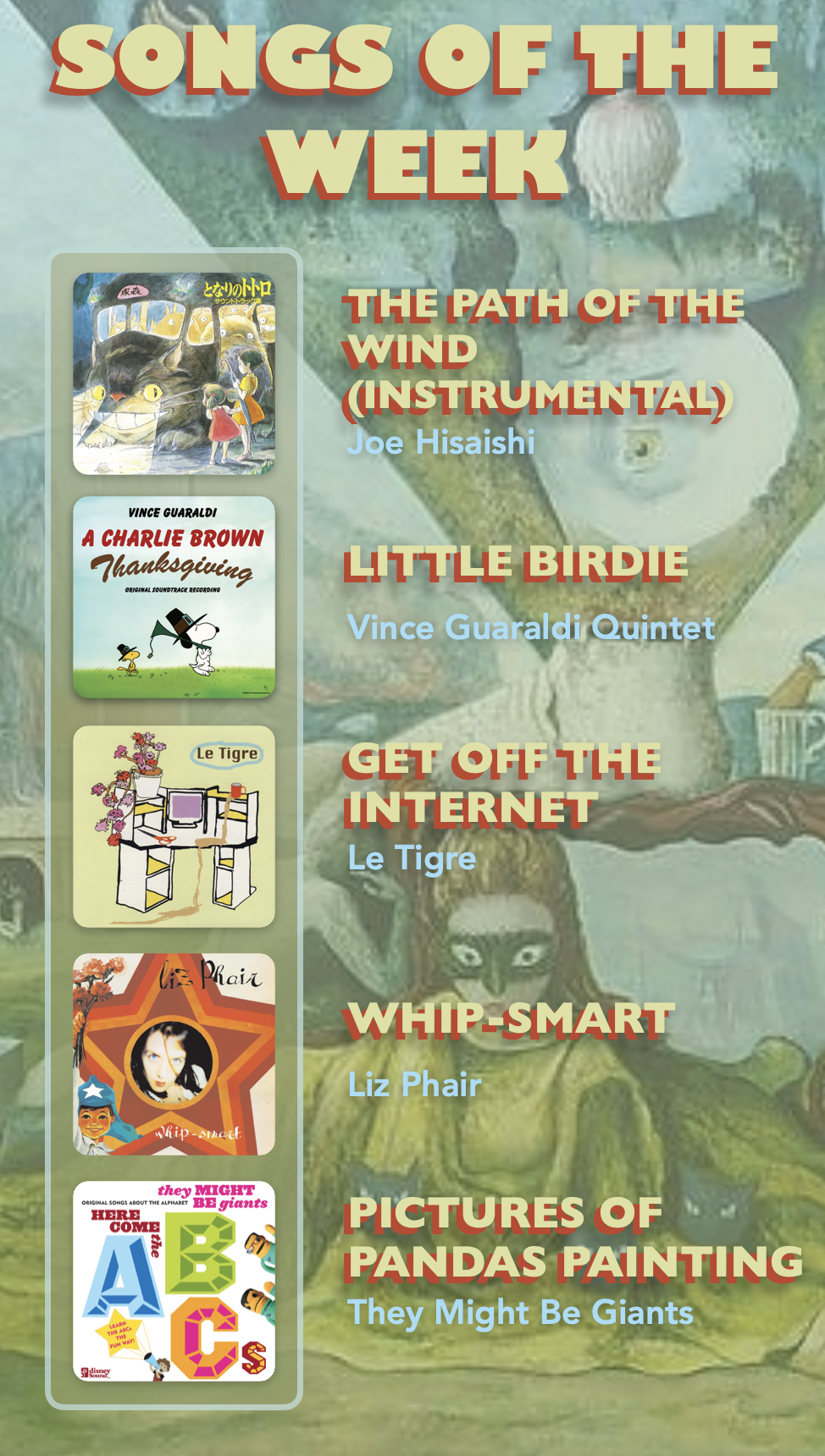
THE PATH OF THE WIND (INSTRUMENTAL) | Joe Hisaishi So, I know I semi-recently wrote about how the stereotypical Joe Hisaishi piano composition was totally blown out of the water by his bold, synthy score for Nausicaä of the Valley of the Wind, but—and don’t tell nobody I admitted this—after reviewing a number of other Hisaishi scores, I think that take may have been a bit misinformed. True, Ghibli playlists seem almost exclusively geared towards serene relaxation with heavy emphasis on Hisaishi’s lilting piano, yet despite these mild-mannered pieces, it seems this style is only half of his discography. Indeed, it seems an eighties Yamaha haunts Hisaishi like the fucking Green Goblin mask, because there’s always at least one ballsy synth outburst on these soundtracks. It’s not really as rare a defiance as I thought—even what I thought to be Ghibli’s defining movie, My Neighbor Totoro, wouldn’t be the same without one.
Since I’m too busy (or too lazy) to write a full Movie of the Month (Movie! Of! The! Month! Max! Todd! Dot! Com!) for every masterpiece I see, I doubt Totoro will ever get an exclusive post, no matter how deserving it may be. Hayao Miyazaki may not remember how hard it is to be an animator under totalitarian employ, but he really does remember how hard it is to be a kid in an adult world they don’t yet understand. This is the beating heart of My Neighbor Totoro—two little sisters and the tension between their two worlds. In ways few movies have ever evoked for me, Totoro effortlessly lets the magical imagination of childhood coexist with the innocent troubles of a family in the midst of medical and moving complications. From the animated way they move about the world to the curious way they move through it, the sisters in Totoro are some of the most realistic children I’ve seen put to screen, and so many of their scenes balancing imaginative discovery and adult responsibility put me in a headspace I thought I’d lost to time.
My Neighbor Totoro is such an observant, whimsical movie, and Hisaishi captures that nostalgic morass of awe and apprehension expertly in his score. The dual, dueling worlds of childhood are even reflected in his absurd musical choices—here coexists said serene piano with almost-abrasive, hissing synths, somehow both dated and wonderful. Even “Path of the Wind,” our pick for this week, exists in this tension (though I wish it didn’t), for there are not two, but three versions under the same name. Today, of course, we’re looking at an instrumental version of the vocal original “Path of the Wind”, but despite its title on the officially soundtrack, I’ve unwittingly picked the lesser-known instrumental version. In fact, the first (and second, and third, and fourth) search results for “Path of the Wind Instrumental” are all what we’ll hereafter call the orchestral version—an arrangement made for an orchestra rather than the instrumental ripped directly from the vocal version. Confused yet? You’ll catch up.
While, okay, the orchestral version is objectively the best of the bunch, it’s not on the actual soundtrack album (as far as I can tell), and it’s not what we’re here to talk about now, is it then? The instrumental version I’ve highlighted tonight—and boy, is it an earworm—proves my point about Hisaishi’s stylistic duality because, unlike the orchestral take’s sweeping, fantasy strings, the punchy yamaha hits in the instrumental take trade classical elegance for a quirkier beep-booping melody. Less like rolling, rural rice farms glistening green and dewy, this version has a more whispery glimmering, like a nocturnal forest alight with flickering wisps. Without a children’s choir filling its empty space, this track takes on a dated documentary style that, like Nausicaä’s soundtrack, I have a serious soft spot for. While I can absolutely see some finding this song’s repeating jingle annoying after just three minutes, I’m too charmed to care—“Path of the Wind” gleams with timeless childhood mystery, showing that this synth, though it aged, was a great choice by Hisaishi.
Totoro may be a movie about the inevitable aches transitioning from imaginative childhood to uncaring adulthood, but unfortunately, uncaring adulthood is all some children ever know. Every morning, my Instagram feed is flooded by horrors from the ongoing holocaust in Gaza—children with their hair aflame as their home burns around them, ashen corpses callously bulldozed into mass graves, and most often, survivors perched amongst the rubble begging for their lives with what little internet they find, forced to evolve into social media marketers to feed themselves. “Allah will never forgive you, I will never forgive you, if you scroll;” “if you scroll you kill my family, you kill my nephew, you kill me;” “press the four buttons on the side, use my audio, watch three times;” and the more I watch, the more I see. I see a lot of Miyazaki in one such survivor fighting to feed herself and her daughter, Amani Alkhereibi, an artist out of Gaza who teaches children while she’s not expanding her portfolio in hopes of a fine arts residency abroad. Despite her home and supplies being buried under rubble, she spends time ensuring children keep creating despite the destruction around them as a volunteer art instructor for the Small Hands Initiative. To help Amani afford food and art supplies, please donate here. If you can’t contribute today, there will be more opportunities soon, as I’m hoping to post new campaigns with every Songs of the Week post. I know my platform consists of, like, ten people (and a huge thank you to those ten, as usual), but I’m trying to do good with what I have. I may not be in the midst of bombing runs or forced famines imposed by the inhumane IDF, but it’s getting pretty scary here in the US, and I want to make a habit of standing for what’s right before my own community’s on the line. With Israel’s scopes now fixed on Iran, secret police deporting immigrants regardless of their legality and firing rubber bullets at reporters, tanks parading into DC, and senators being detained for expressing professional dissent, the world stands on a precipice, and I’m certain we’re far from the worst of the storm. If we help each other out now, they can’t turn us against each other later. This isn’t all I can do, but it’s how I hope to start. Stay strong, and remember what’s worth fighting for: a world where children can imagine again.
Pairs Well With: “Precipice” (Aaron Cherof), “Ships and Clouds” (Jim Noir), “Circles” (Ron Forbes) [Reviewed 02/23/2023]
LITTLE BIRDIE | Vince Guaraldi Quintet So, even when this was first scheduled in December, it was gonna be late for Thanksgiving, but we’ll half to settle for approximating “Little Birdie’s” half-birthday. Incidentally, I first found A Charlie Brown Thanksgiving and what should’ve been its breakout single somewhere around its fifty-first birthday—thank god for that, because as it turns out, neither this tune nor the rest of its soundtrack was officially released until its fiftieth anniversary on October 20th, 2023. That’s because unlike A Charlie Brown Christmas, Thanksgiving’s tracks were never recorded for commercial release, and this fiftieth anniversary album might never have existed were it not for the discovery of deceased producer Lee Mendelson’s archival assets over Covid, resulting in this rough-but-remastered record. It was super thoughtful of Mendelson’s relatives to go digging for these tapes just so I could listen to “Little Birdie” forty thousand times. I can sort of understand why A Charlie Brown Thanksgiving wasn’t a radio hit back in the day if it never even saw the light of said day, but I’m surprised there weren’t riots in the streets when it wasn’t available in record stores, because god damn, the Vince Guaraldi Quintet was cooking hibachi style. The only reason I haven’t been clamoring for its release (like I’d do for far lamer documentary soundtracks) is because I didn’t know what I was missing. I hadn’t actually seen A Charlie Brown Thanksgiving until last November—a little late on the uptake, sure, but I’ve seen the other two in the Peanuts holiday trilogy, so if you want better evidence that I live under a rock, look elsewhere, Satan. I digress.
Really, though, I know Vince Guaraldi was a jazz hotshot in many other ways, but none of his work I’ve heard is nearly as funky as “Little Birdie.” That’s not a slight to his instantly-iconic, minimalist material—anything on A Charlie Brown Christmas could pass at a sophisticated poet dinner where everyone’s a little bit in love with themselves (but they think it’s tension with each other), and (said in a completely separate tone) that album will always feel warm and fuzzy for me. That said, the addition of a trumpeter and an extra bassist boosts “Little Birdie’s” sound into the stratosphere, reinforcing the solid sound-wall all locked-in jazz musicians raise when they play—there’s not a gap missing here, and it really fuckin’ rocks.
I guess maybe “funkin’ funks” is the more precise phrase, as I said earlier. This stylistic shift is one of several risks Guaraldi took with this soundtrack, alongside, that’s right, singing on “Little Birdie” (yea, that’s him, and he could’ve seduced everyone at the aforementioned poet party. I have this image of him, like Shel Silverstein, being this undeniable slimeball oozing charm. Vince, you old smoothie). Though Guaraldi was indeed in his forties while composing these pieces, to keep a finger on the musical pulse, he regularly collaborated with musicians in their twenties, which explains the very contemporary East Bay percussion and Stevie Wonder horns. By straying from the simplicity of A Charlie Brown Christmas, Guaraldi’s experimentation, according to this somewhat demeaning All About Jazz review sacrifices timelessness since it sounds so inseparable from the early 70s, but I’d hardly dock points for this distinct, dated identity. Blasphemous as it may be, I’d go so far as to say the funk infusion here makes Thanksgiving’s version of “Linus and Lucy” my personal favorite, with its punchy bass. God, it’s so fucking cool. For real. I suppose you don’t want your audience foaming-at-the-mouth-funked during the middle-aged disputes of Peanuts’s crotchety, old-soul cast, but I’m not going to apologize for Guaraldi’s choice. It made for a hell of a Snacksgiving montage. Normally I’d include the accompanying video for this needledrop, but the entire time I was watching the Thanksgiving special I was jamming so hard to this that I couldn’t commit any of Snoopy and Woodstock’s couple’s therapy session to memory. Sue me, Guaraldi’s just too good to be in the background.
Pairs Well With: “Linus and Lucy” (Vince Guaraldi Quintet), “I Wish” (Stevie Wonder), “Fireworks” (Lynn Ahrens perf. Grady Tate)
GET OFF THE INTERNET | Le Tigre Uh oh. I feel a man moment coming on.
After seeing foundational feminist punk band Bikini Kill live on their farewell tour last fall, I’ve regrettably decided I like front(wo)man Kathleen Hanna’s other band, Le Tigre, better. Don’t get me wrong, I had a good time—an obligatory “wouldn’t pit two queens against each other” is in order, in more than one way—but seeing how Hanna and drummer Tobi Vail interacted with the crowd showed me that though their message is the same, their approaches almost seem opposed.
Right from the get-go, though, I’ve got to establish that this isn’t at all about which approach “works” in political communication. I’m not about to be the bro who lectures women on how to fight for women’s rights; I’m just trying to say what resonates with me as a listener. To her credit, multi-instrumentalist and music critic Tobi Vail is arguably just as instrumental in starting the “riot grrl” campaign in punk, having even invented the iconic “grrl” spelling (which feels weird to list as an accomplishment above everything else, but like… I think it shows that she was there from the start). Because of her hardline influence, women have clawed out a more welcoming community from what was once a male-dominated punk scene. Towards an audience of primarily women, though, she wasn’t the most welcoming. Her interjections between songs weren’t anything, like, nefarious, just Portlandia eye-roll-y— “anyone here know A.S.S.? …no? I just figured being from Denver, you’d all know about such an influential feminist band out of Boulder.” That’s paraphrased (in my numerous searches, I haven’t found a trace of ass), but the sentiment isn’t—it wasn’t militant, exactly, but a bit pretentious.
Where what little Vail I experienced came off as exclusionary, singer Kathleen Hanna’s energy was an absolute blast. From what little I’ve heard about her recent biography Rebel Girl, she’s certainly not a character who takes any shit, but her attitude was so candid, silly, and radically friendly despite everything she’s been through in a way I really resonated with. It wasn’t just that she randomly apologized for her singing bubbly because of the yogurt she’d just eaten—it was that she held her humor in balance with her very real anger at the state of the world, and advocated for fueling oneself with joy instead. She reminded me of another hero of mine, my mom, who I think embodies unflinching feminine strength without ceding her sense of humor to the darkness, which I think, taken together, is an honest centeredness few people show fearlessly. I know, especially nowadays, we need to have our fight faces on, but I admire deliberate vulnerability more—it’s not innocent, it’s mature and human.
Fortunately, Hanna’s energy comes to the forefront in her work with Le Tigre (french for “The Tigre”), which seems to prioritize playful tinkering despite its punk-ish preferences. Though I found Le Tigre (in a rare instance coincidentally separate from my parents, who are also fans) from their deservedly renowned and undoubtedly punk piece “Deceptacon,” today’s pick is both decidedly different and distinctly Hanna. Off of From the Desk of Mr. Lady (an excellent album title), “Get Off the Internet” is exactly as candid, direct, silly, and serious as I’ve described Hanna. If you couldn’t tell from the title, this song doesn’t mince words, with an exasperated, spoken chorus that’s unmistakably a call to action: “(Get off the internet!) / I’ll meet you in the street / (Get off the internet!) / destroy the right wing.” While I haven’t been heeding Hanna’s advice enough lately, I’ve been repeating it a whole lot, because for better or for worse, the song is irresistibly catchy. Unlike the hoarse shouts and anime-smackdown guitar that make “Deceptacon” so lovably raw, “Get Off the Internet” consists of a stiff, electronic mix—an expertly calculated groove that’s still rough enough to be punk. I wasn’t able to discern if this is a sample collage or loops of Le Tigre’s homegrown sounds, but whatever they’re doing, they’re doing great—the blunt bass blares, the jilted marimba jangles intentionally just out of tune, and faint, scratchy ruffs like a sticking CD jump in when bass abruptly cuts. Most of all, it’s the pauses that sell this lumbering clutter—each instrument metronomically thunks, all chugging rustily in time like thrifted, vintage machinery in a windup robot, loyal but faltering with age. Unlike so many songs I’ve complained cut off too soon, this machine is allowed to run its course for another minute after the lyrics stop—a repetitive breakdown that, granted, has potential to become grating à la “Path of the Wind,” but it itches my brain just right most days.
This distinct sound and rhythm, combined with its hodgepodge, proto-Youtube vibe (embodied still by musicians like Louie Zong) lends “Get Off the Internet” to visuals. This is the thing I feel most cringe about saying, but I always imagine this instrumental over a video in the style of the album cover, framed top-and-bottom by a line of low frame rate kittens doing that stiff-legged walk kittens do. Think of the optics—with lyrics like these, it’ll look a lot less like goose-stepping. I feel like I can’t sell this without others seeing it, but it’s harder to argue that this song doesn’t need a choppy, indie video.
As much fun as “Get Off the Internet” is, though, I can’t say I enjoy all of it. Much as I appreciate their kick in the ass, I don’t like all of the lyrics—wait, wait, I know that sounds bad, but I promise this complaint is purely mechanical. Mechanical is, as I’ve said, a word I’d use to describe this song’s precise steps, which unfortunately makes it all the more obvious when words misalign with the meter. Lines like “Am I Crazy / Nothing has changed” just don’t hit with the rest of the song’s bluntness because, at least to me, they’re stretched unevenly over a longer measure. Maybe this is harsh, but it flings me back to tinkering with lyrics in elementary school. My friends and I would always attempt to parody nursery rhymes and such, but always fell short of the greats (“jingle bells / Batman smells”) because, at least in my case, I could never find the right words to land a joke on the beat—it’s harder than Captain Sparklez would have you believe. Not trying to give my critique a tragic origin or anything, that’s just where this song sends me. Of course, this is a very internet-y complaint, and I’d hate to cage Le Tigre in fascist meters. If I’ve got a voice to complain, like Hanna says, I should use it where it actually matters.
Pairs Well With: “Well Well Well” (Le Tigre), “Chicken Bone” (SYDNEY with sister R), “Cats & Dogs” (Louie Zong)
WHIP-SMART | Liz Phair While we’re on beep-boop feminism, I’d be remiss not to mention this delightful feat in jingle-gizmo engineering from Liz Phair that recently re-emerged from my childhood. Cards on the table, I can’t say I’ve listened to nearly as much Liz Phair as physicians advise. From what little of hers I’ve heard, I’ve always conceived of her sound as “mid-nineties angry grrl” akin to Fiona Apple, PJ Harvey, or Tori Amos, so it was a shocker to discover that she was behind this “late nineties quirky grrl” song akin to Transvision Vamp, Luscious Jackson, or New Pornographers. It’s a surprise, to be sure, but a welcome one, because this alternative sound hardly needs to stretch to scratch both my pots-and-pans and well-crafted kids song itches. Though its drum intro tricks me into thinking Blur’s “Song 2” is about to start, “Whip-smart” instead skitters into a calm sing-song atmosphere of jangly acoustic and synth cicada chirps. Though some sounds here—including Phair’s low, flat delivery—belong in a lullaby, there’s nothing sleepy about “Whip-smart’s” forward momentum. When harmonized, what were once borderline-bored vocal tracks (a perfect fit in this context) crest in an almost euphoric chorus that, I dare say, is veritably headbangin’. With its nursery rhyme structure, giddy harmonies, and clickety-crickety instrumentation, this is the perfect song to hook your kid on Liz Phair early, which… hey, wait a minute…
That’s probably why, like so many songs I’ve spoken about over the years, “Whip-Smart” was my backseat soundtrack on many drives to elementary school—a song I didn’t know the name of, but loved nonetheless. For the longest time, I’d have the catchy chorus of this anonymous song— “when they do the double dutch, that’s them dancing”— rattling around in my head without the slightest clue what it could be, obfuscated even more by the two other double dutch-related songs I often heard at the time—Elvis Costello’s “New Amsterdam” [Reviewed 12/28/2023] and They Might Be Giants’ actual kids song, “Ooh La! Ooh La!” (more on them later).
Those alliterative lyrics are probably so sticky by design, much like “Whip-Smart’s” other playground qualities—though not a kid’s song itself, it is pretty transparently Phair’s daydream aspirations for raising a son to be better than the men in her life before. Announcing “I'm gonna tell my son to grow up pretty as the grass is green / And whip-smart as the English Channel's wide” from the outset, there’s a warm optimism in Phair’s aims to raise what we’d call “a man written by a woman today”—a boy unafraid of the femininity his mother gave him.
While I’m moved by this beautiful sentiment, Phair’s recipe for a better boy is infused with her own unsealed wounds, veering “Whip-Smart” into potentially vengeful territory. The very idea of “raising better men,” after all, implies righting the bottomless wrongs of men before, which is why Phair says she’ll “write [her] whole life story / On the back of his big brown eyes,” imparting not only her parental wisdom, but her trauma, too. The particular line that ooks me out is where Phair declares she’ll “lock [her] son up in a tower / 'Til he learns to let his hair down far enough to climb outside—” girl, what? This, of course, could go one of two ways. Understanding the universal trials of womanhood in order to foster respect and empathy for women in adulthood is, I think, an essential lesson for men on multiple levels—even many of our earliest heroes, like Odysseus or Arjuna, endure metaphorically “living as women” under circumstances that invert patriarchy in order to become whole. However, there’s a shadow implication here that Phair is crafting a son to pay penance in the place of the past men who have wronged her, with Phair going so far as to cast herself as the devouring mother in Rapunzel. In this scenario, Phair is—perhaps unwittingly, but I should give her the benefit of the doubt—projecting her trauma on this hypothetical son, as though it’s just that he be born into other mens’ debt. Like I initially said, I know very little about Phair, so this isn’t accusatory in any sense—I just fear for the children who bear their parents’ baggage. Luckily, this song was written far before Phair’s actual son was born, so I doubt it’s autobiographical—even if it is, its uncomfortable qualities are balanced by truly beautiful hopefulness and lyricism.
Pairs Well With: “Pressure Time” (Transvision Vamp), “Wraith Pinned to the Mist and Other Games” (Of Montreal), “Mass Romantic” (New Pornographers)
PICTURES OF PANDAS PAINTING | They Might Be Giants So, it’s been a few years since my controversial comment that Laurie Berkner “poured all of [her] God-given talent into writing kids' songs,” and while I refuse to retract my statement, I will admit it’s past due for a Songs of the Week to give the true superheroes of kids’ music their flowers. They Might Be Giants may not strictly be a kids’ band, but that’s exactly why, in my eyes, they did it best—these multi-talents are so straight-up strange that their authentic expression can pass in any demographic. These nerds easily skirt from punk to klezmer to bossa nova, and sometimes even within the same song—“Fingertips,” a four-and-a-half minute compilation of five-second, random jingles that closes their album Apollo 18, might be the best distillation of this essence—but that’s not what makes them special. No matter their genre, these guys have such a distinct flavor of imagination and humor that it all sounds like They Might Be Giants—even talking to toddlers and twentysomethings alike. Much as I like to think I’m defined by an immutable, central nature within myself rather than being the result of arbitrary nurturing (a bad argument for someone who turned out a lot like his parents), my current, scattered music taste might admittedly have started with TMBG’s incredible, eclectic kids’ trilogy: TMBG: Here Come the ABCs, TMBG: Here Come the 123s, and TMBG: Here Comes Science. Sure, some songs I naturally never loved (a preference that, at five, I can’t explain beyond saying it had been in my soul from the start), but this mixture—or perhaps the weird thread running through it—must have had a hand in my elevated taste today. Yea, I’m something of a connoisseur, how did you know? Let’s return to the ABC symphony, shall we?
Amongst TMBG’s ABCs genre smoothie, “Pictures of Pandas Painting” wasn’t a standout as a kid, but when it came inexplicably back to me recently, I was like… holy shit, is this insanely good? Seriously, I’d lose my mind if I saw this live. Like many concepts this band is unafraid to introduce without condescension, “Pictures of Pandas Painting” is a startlingly jammy piece for its intended audience, making it sort of a “baby’s first psychedelic freakout.” With its blasting sax, shredding guitar, and helicopter synth, this could easily pass for an “adult” song—like much of their discography, its intended audience is a bit ambiguous, what with their universally quirky lyrics. Unlike a lot of repetitive kids’ songs, there’s relatively complex dynamics at play here, which sounds not-so-fun spelled out with words but is a blast in musical form. As great as the guitar and horns are here, I’d be remiss not to mention the way the synth flickers in, flashing at a zootrope’s tempo. I think I’ve struggled to find these words before, but its combination of fast and slow-paced moving parts gives “Pictures of Pandas Painting” disorienting layers of speed—a key ingredient in creating a psychedelic, spinning pace. Mirroring the lyrics “Pictures of pandas painting / pictures of pandas painting / pictures of pandas painting,” this song is built to spiral, which is probably why I love listening to it these days.
Of course, not every trip spirals pleasantly, and the accompanying video on ABCs’s DVD veers into teletubbies territory that, even as a kid, I found kind of uncanny (which might explain why this initially evened out to being a middle-of-the-road track). Check it out:
It’s nothing insane, but it’s kind of off, right? Do you guys also fear for the unsupervised toddlers being absolutely brain-blasted by Spider-Man x pregnant Elsa Granny Gameplay or barely-disguised busty anime Minecraft zombie fart fetish videos that autoplay on Youtube Kids? After the obvious moral revulsion when one stumbles into my feed (which is, to be clear, much more concerning), I also just sort of worry what shitty animation quality does to a developing brain. Obviously, after revisiting this, I’m realizing I saw plenty of bizarre and badly-animated stuff during those years and turned out… alright. Maybe I should be more concerned with the content of Spider-Man x pregnant Elsa Granny Gameplay or barely-disguised busty anime Minecraft zombie fart fetish videos than the animation quality. Idk dawg, their surface is just as much brain gruel as their insides. Man, what was I even talking about?
Right. Okay. So I guess these hippos on yoga balls aren’t as deeply disturbing with that perspective, but I really do feel “uncanny” is the right term for this whole experience. Every syrupy movement has a moonlike weightlessness, with nothing but haze behind these bobbling animals’ eyes. It’s an endearing effect when the titular pandas are painting in bemused daydream, but it feels way out-of-whack during the skateboarding portion. Then again, that might be because the pandas have, uh, human bodies? In fact, none of the animal assets here seem to have been made in the same style; while the pandas appear rotoscoped over human actors wearing mascot heads, the penguins appear to be traced over a more realistic render, and the hippos—easily the eeriest of the bunch—appear to be in a Back at the Barnyard, ugly, faux-claymation style more at home in media that would’ve incepted nightmares in me at that age. It’s not an inconsistency I noticed then, though there’s always been a mismatch thats’s confused me.
This really goes to show what a nitpick dictator I’ve been since the beginning, because part of my initial dismissal was to do with the lyrics. Let me set the scene for you: each stanza starts as a loop of alliterated P-sentences, with “Pictures of Pandas Painting” eventually leading to “Penguins Proudly Parading Past.” So, we’re doing a song about the letter “P,” and it’s got a recurring structure, right? Next stanza: “Skateboards.” That’s it. Fuck me, I guess. And now it’s about the letter H? Where is the consistency? Why have we totally abandoned the alliteration tessellation that the lyrics establish earlier? What does this even have to do with the alphabet?! As a kid, I would go a little crazy trying to conceptualize this song too hard, and it ended up feeling like a flopped concept—after all, the best art is about picking strict rules and predictably sticking to them. A little wisdom from toddler Todd for you.
What that little guy, God bless him, wasn’t as aware of was how influential the ending image in this video would be. When I’d long forgotten all of those churlish hippo grins, the only thing I remembered from this video upon revisiting it was the ending shot of the panda holding a picture of a panda holding a picture on and on into infinity—an image I’m surprised transfers intuitively to children’s visuals. Pretty cool to see the essence of psychedelia translated into a digestible form for little tikes. Baby’s first psychedelic freakout scoring baby’s first sublime ego death? Love these guys. Thank you, They Might Be Giants.
Pairs Well With: “5 O’ Clock World” (Julian Cope), “The A Song (Laid In Your Arms)” (Spiritualized), “Planet Telex” (Radiohead)
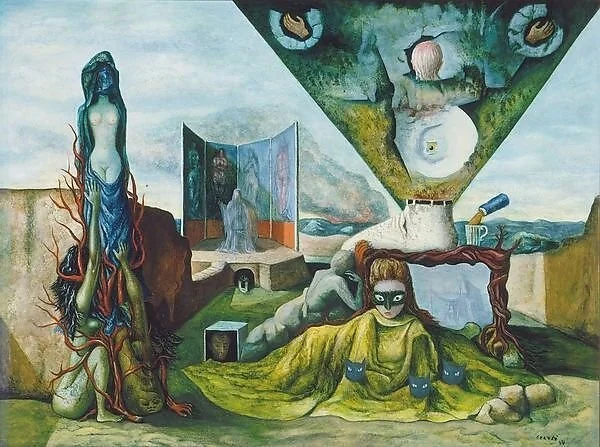
LOS DÍAS DE LA CALLE GABINO BARREDA | Gunther Gerszo So, I don’t know how many Trident Booksellers and Café fans we got in the audience, but here’s one more reason to adore that beautiful hipster glue trap—they’ve got authentic Gunther Gerszo on the walls! If you haven’t heard of Gunther Gerszo, don’t worry, I hadn’t either, but I have heard of Mexican surrealist Remedios Varo, a favorite of both mine and his. As part of the Mexican modernist scene, Gerszo was friends with Remedios Varo, with this piece being a tribute to her style—if I’m not mistaken, she might cameo in the bottom-left blanket cocoon, characteristically in a pile of cats. You can really tell her style rubbed off on him here, seeing as this piece doesn’t resemble his usual geometric, abstract stuff. What a sweet, vibrant tribute, right?
Again, if you haven’t already, please donate to help Amani if you can and stand up for your community elsewhere if you can’t. Saving the world is just too big for one person, but everybody’s got their thing to do, so keep doing it and do it selflessly. I don’t want to add to the din that’s got me feeling so bleak, but fear is how they beat us down. Free Palestine, free Ukraine, and fuck ICE. Stay safe, everyone.